Eviction Data Response Network (EDRN)

Project Overview
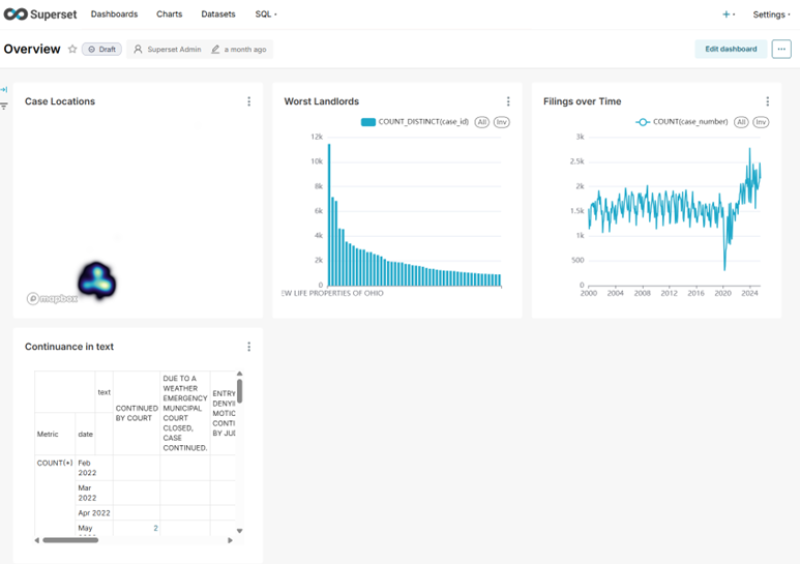
Evictions represent a critical social and economic crisis across the United States, highlighting a significant gap in affordable housing and a steady rise in housing instability. Central Ohio, and specifically Franklin County, has been hit particularly hard; in 2016, the city of Columbus recorded more total evictions than Chicago. By the end of 2024, 25,329 evictions had been filed in the county—nearly 2 filings for every 100 residents. Despite the scale of this crisis, eviction data is often fragmented and difficult to access, leaving a major gap in local, up-to-date numbers and a lack of comprehensive visualization tools.
To bridge these gaps, the Center for Urban and Regional Analysis (CURA), in collaboration with JusticeTech at The Ohio State University, is developing the Eviction Data Response Network (EDRN). This project builds upon the groundwork laid by Jeff Bihl, whose efforts in developing the Eviction Monitor provided essential visibility into the frequency and location of filings. By centralizing these data efforts, the EDRN aims to address the current lack of understanding regarding how specific policy interventions directly impact eviction rates and tenant outcomes.
Collaborators
As part of this initiative, the team participated in the New America EDRN inaugural cohort, a national network dedicated to improving local eviction data ecosystems. This partnership with New America was instrumental in connecting Mindy Yocum and Felix Englemann of JusticeTech with CURA, sparking the interdisciplinary collaboration that powers this project today.
Building the EDRN
Project Goals
The EDRN project will create an interactive online dashboard designed to visualize eviction trends across Franklin County. By integrating legal records, spatial analysis, and demographic data, the project aims to:
- Identify "hotspots" and corridors where filings and writs are most concentrated.
- Expose patterns in court procedural trends, such as the relationship between legal representation and case outcomes.
- Support community-centered legal reform by providing policymakers and advocates with reliable, data-driven insights.
- Serve as a resource hub for advocates, researchers, and community members to better understand the eviction process.
Products in Development
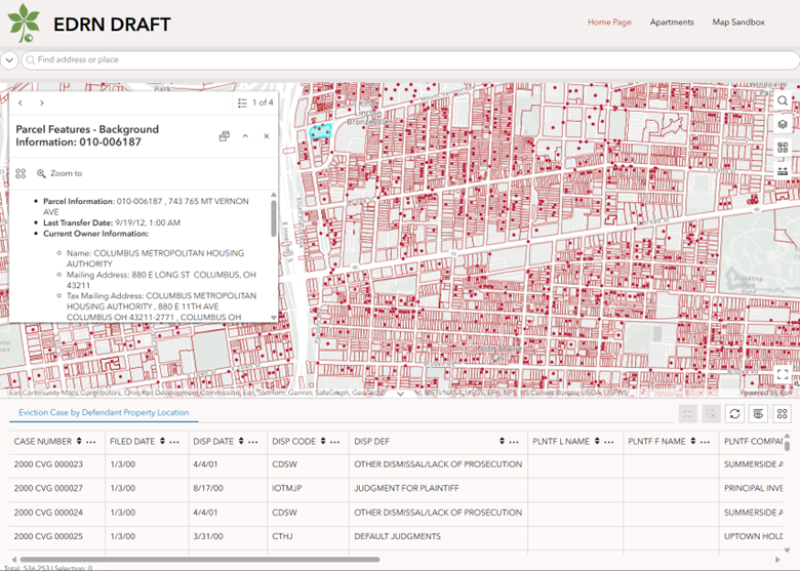
CURA, JusticeTech, along with support from Translational Data Analytics Institute (TDAI), have identified three products that are currently in development:
- A public facing dashboard with aggregate and summarized trends
- A secure map to support advocate with a property history of eviction, code, 311 cases and property ownership information.
- A secured online database of raw de-identified eviction data for deeper data exploration and research.
The EDRN has completed the initial work of product and data needs assessment, especially for advocates and community service providers. The data pipeline for the raw data from the court is nearly completed, and test version of the online search has been completed. The next steps include finishing the automation of data updates, initial testing of the advocate search map, and building the public facing dashboard