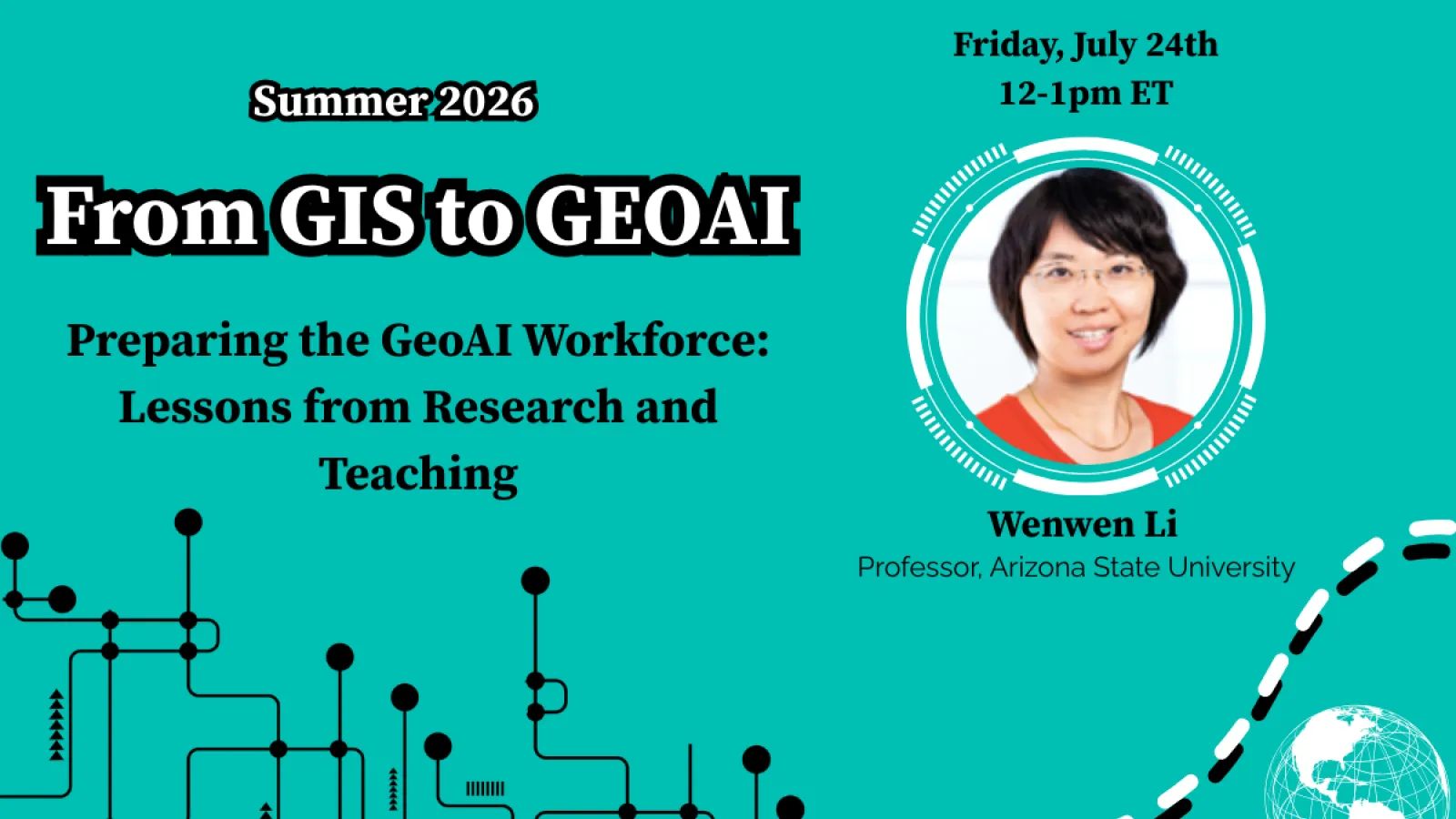
GeoAI has rapidly emerged as a new frontier in geographic information science, creating both opportunities and challenges for geospatial education. In this talk, Wenwen Li will reflect on a decade of research exploration in GeoAI and discuss how these experiences have shaped our approach to preparing the GeoAI workforce. Working alongside GIScience students, we have treated education and research as a coevolving process, learning the field while training the next generation of scientists. She will highlight several research projects where GeoAI plays a key role in advancing environmental monitoring and scientific discovery. Wenwen will also discuss emerging challenges in an era when large language models are increasingly used in the research process. Finally, she will share strategies we are exploring to help students develop strong spatial thinking, along with the AI and computational skills needed to responsibly and effectively use these technologies in geospatial science.
Dr. Wenwen Li is a Professor of Geospatial Data Science in the School of Geographical Sciences and Urban Planning at Arizona State University, where she directs the Spatial Analysis Research Center (SPARC). Her research focuses on cyberinfrastructure, big data, and geospatial artificial intelligence (GeoAI), with applications in data- and computation-intensive environmental and social sciences, such as environmental monitoring and Arctic change, disaster management, and clean water access for underserved communities. She is the recipient of the NSF CAREER Award (2015) and the NSF Mid-Career Advancement Award (2021). In 2023, she was elected a Fellow of both the American Association of Geographers and the University Consortium for Geographic Information Science.